




Why Are RIBs So Stable? RIB Stability explained
There is a useful test for boat stability. Put several people on one side. Watch what happens. If everybody suddenly looks at the skipper, you have learned something about the boat. RIBs tend to handle this particular social experiment rather well. That is not an accident, and it isn’t simply because inflatable tubes are soft.
The stability of a RIB comes from the way buoyancy, hull geometry, beam, weight distribution and the inflatable collar work together. The result is one of the defining characteristics of the RIB: a boat that can feel reassuringly solid underfoot while remaining relatively light and agile. But let’s unpack what is actually happening.
(Internal link: What Is a RIB? A Simple Guide to Rigid Inflatable Boats)
First: what does “stable” actually mean?
When boaters say a boat is stable, they can mean several different things. They might mean it doesn’t rock much when people move around. They might mean it feels steady when someone boards. They might mean it doesn’t lean dramatically in a turn. Or they might mean it remains predictable when waves arrive from the side.
These are related, but they aren’t exactly the same thing. A boat’s stability is influenced by its centre of gravity, centre of buoyancy, beam, hull shape, weight distribution and loading condition. So there is no single component you can point at and say:
“That’s the stability.”
On a RIB, however, the tubes are an unusually visible and important part of the equation.
{Simple technical illustration showing a RIB from the front at rest. Indicate the centre of gravity above the hull and the broad buoyancy areas created by the hull and inflatable tubes. Use simple arrows to show how buoyancy supports the boat. Avoid detailed mathematical diagrams. Caption: “Stability comes from the relationship between the boat’s weight and the buoyancy supporting it.”}
The inflatable collar changes the shape of the boat
Imagine a narrow rigid hull without tubes. Now add two large inflatable tubes along its sides. You’ve suddenly made the boat substantially wider at the point where buoyancy is acting. That matters.
When the boat heels to one side, the relationship between the hull, the tubes and the water changes. The tube on the lower side moves deeper into the water and can provide additional buoyant support. The tube on the higher side moves away from the water. As the boat returns towards its normal attitude, the buoyancy distribution changes again.
This is one of the reasons the inflatable collar can contribute so effectively to a RIB’s stability. The tube isn’t merely sitting there waiting for somebody to bump into it. It is part of the boat’s buoyancy system.
Why does a RIB feel so stable at rest?
This is where the tubes really earn their keep. At rest, the boat is supported primarily by buoyancy. The broad inflatable collar places a large volume of buoyant material around the outside of the hull. That creates a wide support area and can make the boat feel very steady when people move around.
It is especially useful for activities where people naturally wander around rather than remain obediently seated:
- boarding
- swimming
- fishing
- handling equipment
- preparing food
- children moving between seats
- getting ashore from a yacht
- loading luggage or dive gear
RIBs are therefore particularly useful as tenders because the stability and buoyancy of the tubes combine with the rigid floor to create a practical platform for moving people and equipment.
(Internal link: How to Choose a Yacht Tender)
But the hull is still doing its part
It would be easy to look at a RIB and conclude that the tubes are responsible for everything. They aren’t. The rigid hull remains fundamental. Its beam, deadrise, chines, weight distribution and underwater geometry all influence stability. A deep-V hull, for example, can provide excellent behaviour when moving through waves, but it may have different static stability characteristics from a flatter hull.
This is another reason the best RIB design is a compromise. The boat needs to behave properly:
at rest, at displacement speed, on the plane, in turns and in waves.
Those are several different jobs. And the hull and tubes have to cooperate through all of them.
(Internal link: Why RIBs Ride So Well: Understanding the Deep-V Hull)
Stability and speed are not opposites
One of the interesting things about a RIB is that it can combine characteristics that might seem contradictory. A boat can be stable at rest and responsive at speed. It can have substantial buoyancy around its sides while still using a performance-oriented rigid hull. It can feel reassuring when manoeuvring around a marina and become remarkably lively when you open the throttle.
That is the whole point of the hybrid design. The tubes don’t replace the hull. The hull doesn’t make the tubes irrelevant. They do different jobs. And when they are designed properly, the result can be unusually versatile.
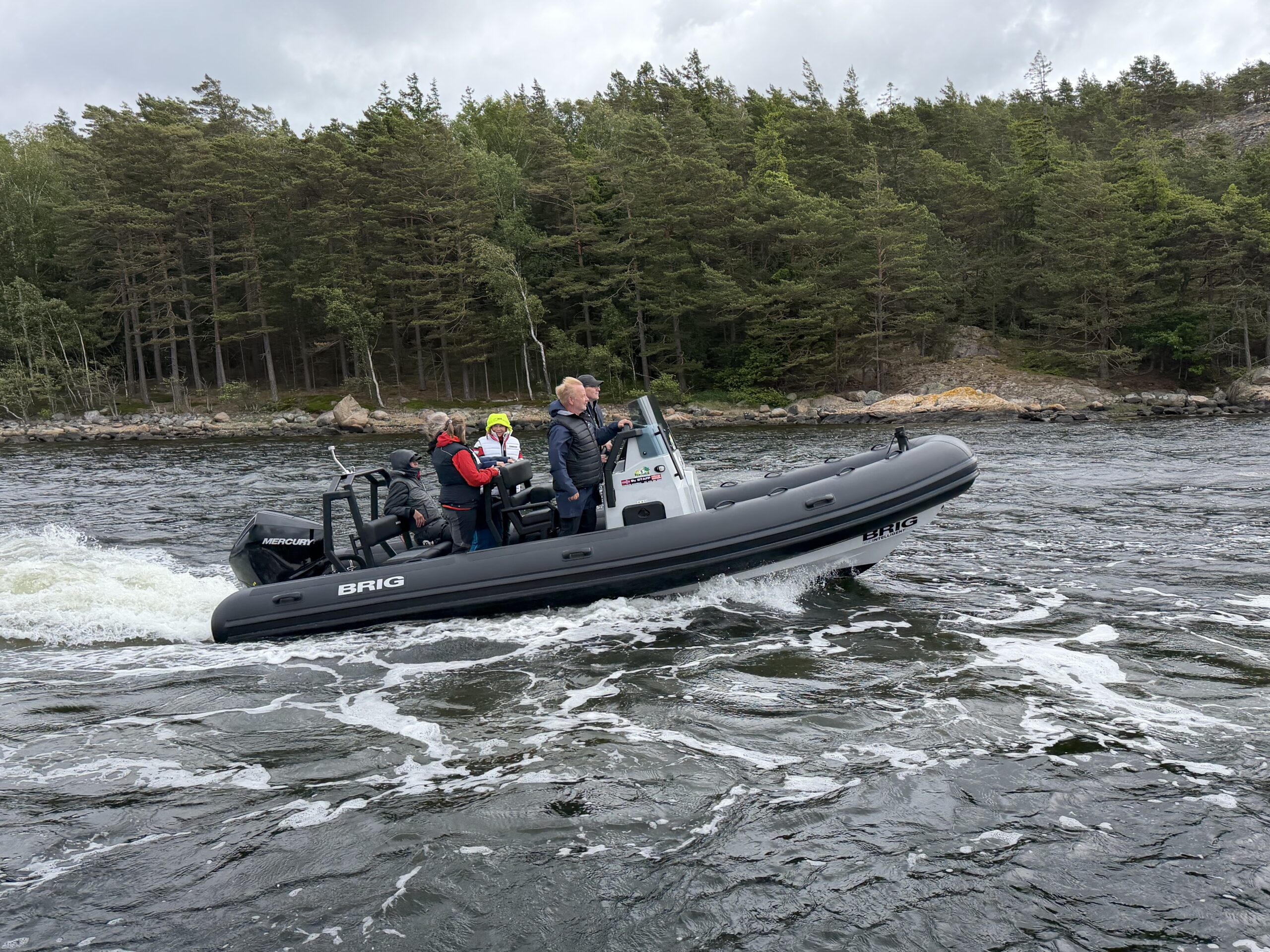
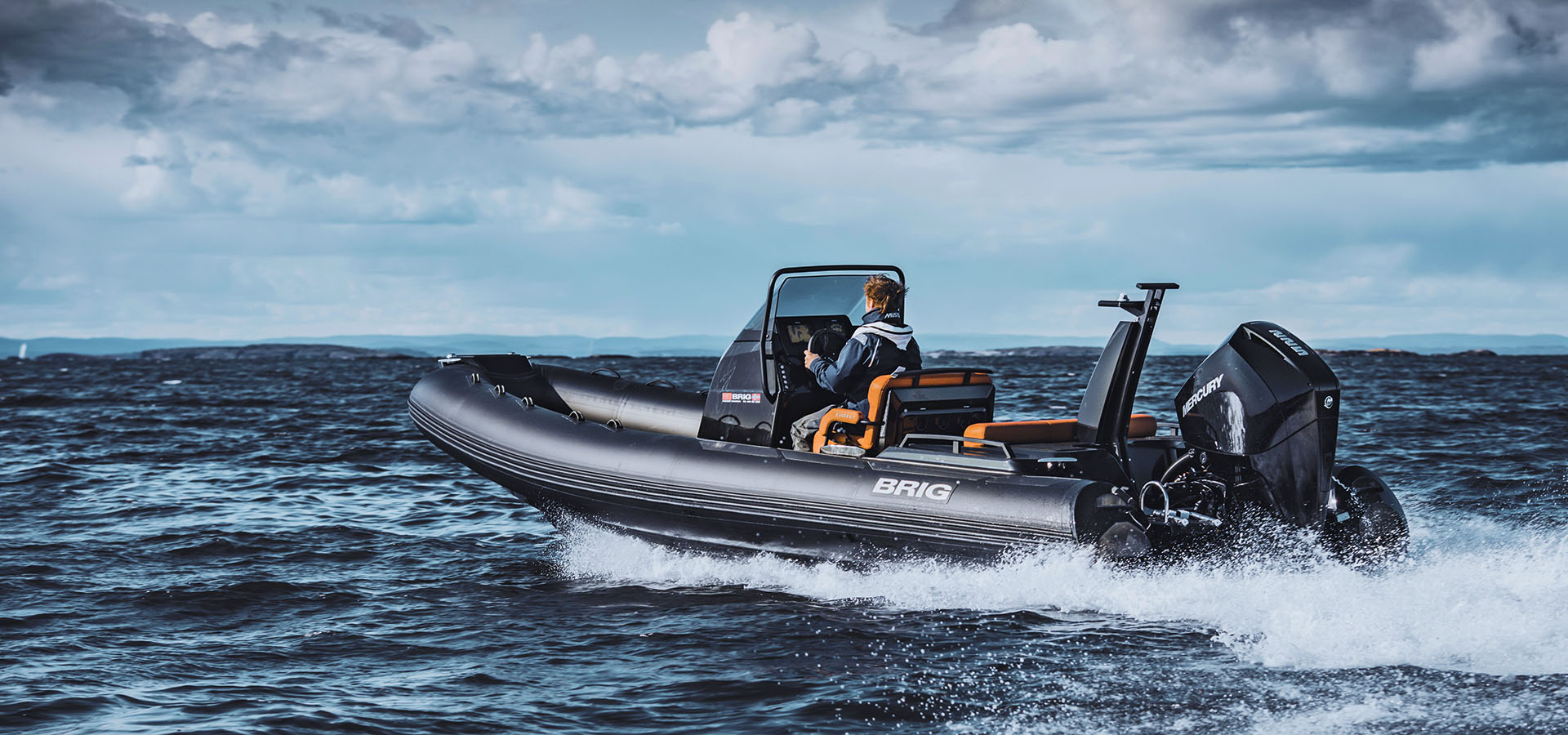
{Action photograph of a BRIG RIB making a controlled, moderate-speed turn in open water. Photograph from slightly ahead and outside the turn so the amount of heel is visible but the boat still looks composed. Avoid extreme racing angles. The purpose is to show stability and controlled handling rather than speed.}
What happens when everyone moves to one side?
This is probably the simplest way to understand the advantage. Imagine four people sitting evenly around a RIB. The boat is balanced. Now imagine three of them decide that something fascinating is happening on the port side. They all move over. The boat heels.
On a conventional hard-sided boat, the change in weight distribution can produce a noticeable change in trim and heel. On a RIB, the lower inflatable tube is pushed further into the water. Because the tube contains a large volume of air, it provides buoyancy at the edge of the boat. That can help resist the heel and restore a more level attitude. This is one reason RIBs can feel remarkably reassuring when people move around.
It doesn’t mean you can ignore the manufacturer’s passenger and loading limits. Quite the opposite.
Good stability is not permission to load the boat however you like.
BRIG’s own owner manuals specify recommended crew positions and emphasise correct passenger accommodation and the use of handholds while underway.
(Internal link: RIB Specifications Explained: How to Read the Numbers)
The tubes are made of air. So how can they carry so much?
Because air is wonderfully light and surprisingly useful when enclosed in the right shape. A buoyant volume doesn’t need to be heavy to support weight. The inflatable collar contains a large volume of air, and that volume displaces water.
The upward buoyant force generated by the displaced water supports the boat and its load. This is basic Archimedes. It is also one of those occasions when ancient Greek mathematics turns out to be extremely useful on a Saturday afternoon.
The practical result is that a RIB can carry substantial loads without needing an enormous solid structure around the outside of the boat. That contributes to the category’s characteristic combination of buoyancy and relatively low weight.
(Internal link: RIB Weight Explained: Why Every Kilogram Matters)
Multiple air chambers are important
Here’s a detail that is much more interesting than it initially sounds. A quality RIB tube is not necessarily one enormous air sausage. The buoyancy tube can be divided into independent airtight compartments.
BRIG’s Navigator 20 owner’s manual, for example, describes a tube divided into five independent airtight compartments, each with its own inflation valve. Why?
Because separating the tube into compartments provides a degree of redundancy. If one compartment loses pressure, the remaining compartments still contain air. That doesn’t mean the boat should simply carry on as if nothing happened. A damaged or deflated tube changes the boat’s behaviour and requires appropriate action. But independent chambers are an important part of the design philosophy. They turn one large buoyancy system into several smaller ones.
{Detailed photograph of a BRIG tube during production with the outer fabric opened or an appropriate cutaway/sample section showing the internal baffles separating air chambers. If an actual production photograph is unavailable, create a clean technical cutaway illustration showing five independent compartments inside a typical BRIG tube. Labels: “Independent air chambers”, “Internal baffle”, “Inflation valve”.}
Pressure matters more than you might think
An inflatable tube only behaves as designed when it is inflated correctly. Too little pressure and the tube loses stiffness and its designed shape. Too much pressure can place unnecessary stress on the fabric and seams. And there is another complication:
temperature changes pressure.
BRIG’s owner manuals specify nominal tube pressures and explicitly warn that pressure can increase significantly when the tube is heated by sunlight. They recommend checking pressure before navigation and adjusting it if necessary.
So if you inflate your RIB early in the morning and leave it sitting in direct Mediterranean sunshine for several hours, don’t assume the pressure inside is still exactly what it was when you finished breakfast. The sun has opinions. And unfortunately, it doesn’t read your owner’s manual.
(Internal link: How to Look After Your RIB Tubes)
Tube pressure isn’t just a maintenance detail
Correct pressure affects the tube’s shape and stiffness. That means it can influence how the tube behaves against the water and how the boat feels. This is why tube pressure should be treated as part of normal boat preparation rather than an occasional chore performed when the boat looks slightly sad.
BRIG’s manuals recommend checking pressure before every navigation. The exact pressure is model-specific, so the owner’s manual for your particular boat is the authority.Don’t use a generic internet number.
(External link: BRIG Owner’s Manuals)
(Internal link: RIB Maintenance: The Things That Actually Matter)
What happens if a tube is damaged?
This is where we need to be careful with the word “unsinkable”. You will sometimes see RIBs described that way. It makes for a memorable headline. It isn’t a useful promise.
A RIB’s buoyancy system can provide substantial reserve buoyancy, particularly when the tubes are divided into multiple independent chambers. But a damaged or deflated tube can still significantly affect the boat. Real-world incidents demonstrate why.
The RNLI has assisted RIBs where a tube or sponson had lost pressure, specifically noting the resulting concern about available buoyancy. The correct lesson isn’t “RIBs are unsafe”. It is the opposite:
Know what gives your boat its buoyancy, look after it, and take damage seriously.
That is good seamanship.
The tube also protects the boat
There is another reason RIB tubes are useful. They make excellent fenders. When you’re coming alongside another boat or a pontoon, the soft outer collar provides a forgiving contact surface.
It can also reduce the chance of the hull or topsides being damaged during normal manoeuvring. This is one of the reasons RIBs have become such popular yacht tenders. The same feature that helps stabilise the boat also makes it rather less stressful to bring alongside a much larger and considerably more expensive yacht.
(Internal link: How to Choose a Yacht Tender)
{Editorial photograph from the dock: a BRIG RIB naturally alongside a larger yacht, with the inflatable tube gently contacting the yacht’s side. No staged “impact”; show a normal, relaxed tendering situation. The photograph should clearly demonstrate the tube acting as a protective perimeter.}
Does the tube make a RIB safer?
This needs a nuanced answer. The buoyancy and stability provided by the tube can contribute to a forgiving and stable boat. The soft collar can help when coming alongside. Multiple air chambers provide redundancy in the buoyancy system. All of those things can be valuable.
But no boat design makes unsafe behaviour safe. A RIB can still be overloaded.
Passengers can still fall overboard.
Waves can still overwhelm a small boat. A tube can still be damaged. Weather can still change. And a powerful engine can still do exactly what powerful engines tend to do when somebody makes a poor decision.
BRIG’s own manuals emphasise correct passenger positions, handholds, loading and operational limitations.
(Internal link: RIB Safety: The Habits That Make Good Boating Better)
Stability isn’t just about the tubes
This is perhaps the most important technical point in the whole article. If you took the tubes off a RIB and replaced them with something completely different, you would have a very different boat. But if you kept the same tubes and changed the hull dramatically, you would also have a very different boat. The final result depends on the interaction between:
Tube diameter
Tube position
Hull beam
Hull shape
Deadrise
Weight distribution
Centre of gravity
Centre of buoyancy
Passenger loading
Engine position
Fuel and equipment
Sea conditions
That is why designing a good RIB isn’t simply a matter of making the tubes bigger. Everything has to work together.
[Ask BRIG Chief Engineer: “Which hull and tube dimensions have the biggest influence on static stability, and which matter most once the boat is underway?”]
Bigger tubes aren’t automatically better
This is another tempting assumption. More tube means more buoyancy. More buoyancy sounds good. Therefore: bigger tubes. Problem solved.
Except that the tubes occupy deck space, influence the boat’s beam, affect visibility, change the relationship between the hull and the water and influence the overall proportions of the boat.
There is always a balance.
BRIG’s current range uses different tube sizes and positions according to the intended role and dimensions of each model. For example, the Eagle 6.7 specifically describes a revised hull and a higher tube position as part of its performance and efficiency characteristics. That’s a good example of the broader principle:
Tube design is part of hull design.
Stability at rest and stability underway are different things
This distinction is worth remembering when reading boat specifications. A boat can feel exceptionally stable while sitting at anchor. Then behave completely differently once it is travelling at 35 knots. Why? Because the forces acting on it have changed.
At rest, buoyancy and weight distribution dominate. Underway, hydrodynamic lift, hull geometry, trim, speed and wave interaction become much more important. That’s why a boat should never be judged only by how it feels tied to a dock. Take it for a proper sea trial. Preferably somewhere the water is allowed to have an opinion.
(Internal link: What Makes a RIB Fast? Hull Shape, Weight and Power Explained)
Why RIBs work particularly well as tenders
Now the pieces start to make sense. A tender needs to be:
- stable enough for easy boarding
- buoyant enough to carry people and equipment
- compact enough to store
- light enough to launch
- manoeuvrable around a larger vessel
- forgiving when coming alongside
The RIB architecture ticks a surprising number of those boxes. The rigid hull gives the tender proper running performance. The tubes add buoyancy and stability. The soft perimeter reduces the consequences of an imperfect approach.
And the relatively low weight of many RIBs makes launching and recovery more manageable. That is why the RIB has become almost synonymous with the modern yacht tender.
(Internal link: How to Choose a Yacht Tender)
(Internal link: From Compact Tender to Floating Lounge: Understanding the BRIG Range)
What does all this feel like from the helm?
The technical explanation is useful. But eventually you have to get back on the boat. You step aboard. Someone else steps aboard. Three more people arrive carrying bags. The boat barely seems bothered. You leave the pontoon. The hull settles into its running attitude. A wave arrives from the side. The boat moves with it rather than feeling like it is negotiating a personal disagreement.
And suddenly you understand the tubes. Not as an inflatable accessory. Not as a giant fender. Not as something that makes the boat look different. But as one half of a carefully engineered system. The rigid hull gives the RIB its running personality. The tubes give it buoyancy, stability and forgiveness.
Neither half tells the whole story.
The interesting boat is what happens between them.
[Ask BRIG Chief Designer: “If you could remove one feature from a modern RIB and make the customer understand why it matters, which one would you choose?”]
(Internal link: Why RIBs Ride So Well: Understanding the Deep-V Hull)
(Internal link: How to Choose the Right RIB for Your Life on the Water)
(Internal link: How to Look After Your RIB Tubes)
(Internal link: RIB Safety: The Habits That Make Good Boating Better)