



When looking at a RIB, most people notice the overall shape first: the length of the hull, the inflatable tubes, the console and the seating layout. But if you look underneath the boat, you will find a collection of smaller features that are just as interesting.
Along the bottom and edges of the hull, subtle changes in shape help influence how the boat interacts with the water. Chines, strakes and spray rails are three examples. They may look like simple ridges or angled surfaces, but each plays a role in the way water flows around the hull.
These features do not work independently, and none is a magic solution for a better ride. Their effect depends on their shape and position, as well as the hull’s overall geometry, the boat’s weight, its speed and the conditions in which it operates.
Understanding the basics, however, makes it easier to appreciate why hull design involves much more than choosing a V-shaped profile and adding an engine.
1. What are chines?
A chine is the transition or edge where two surfaces of a hull meet at an angle. On many planing boats, you can see the chine where the bottom of the hull meets its side.
The shape of this transition varies between hull designs. Some chines are relatively sharp, while others are more rounded or incorporate several changes in angle. These differences affect how water separates from the hull and how the hull develops lift as it moves.
On a RIB, chines are part of the rigid hull rather than the inflatable tubes. They contribute to the way the boat interacts with the water, influencing characteristics such as spray behaviour, lift and handling.
A chine can also contribute to lateral grip when a boat turns, although the effect depends on its geometry and how the hull is operating. It is not simply a case of making the chine sharper to improve every aspect of performance. Hull designers have to consider how the boat behaves at different speeds and angles of heel, as well as how it responds to waves.
The important point is that a chine is not merely a line in the hull’s appearance. It marks a change in geometry that influences the flow of water around the boat.
{Illustration: A close-up photograph of a RIB hull viewed from below or at a low angle, with the chine clearly highlighted. Add a simple cross-sectional drawing showing where the bottom surface meets the side of the hull.}
2. What are strakes?
Strakes are longitudinal ridges or raised features running along the bottom of a hull. Depending on the design, they may be relatively small or more pronounced, and their number, height, shape and position can vary considerably.
One of their main functions on many planing hulls is to influence the flow of water beneath the boat. Strakes can contribute to lift and help manage the way water moves across the hull as speed increases.
They can also influence directional behaviour and the boat’s response to steering inputs. The exact effect depends on the hull and strake geometry, so it is not accurate to assume that adding more strakes will automatically make a boat faster or more stable.
Their position is particularly important. A strake placed in one area of the hull interacts with the water differently from one placed closer to the keel or chine. Designers must consider how these features work together across the hull’s length and how their effects change as the boat accelerates, turns or meets waves.
For the owner, strakes are a reminder that hull performance is the result of many small design decisions working together. The lines running along the underside may appear modest, but their geometry is part of the boat’s overall hydrodynamic design.
{Illustration: A clear underside view of a RIB hull, with the longitudinal strakes highlighted. Pair it with a simple bottom-view diagram showing the keel, chines and strakes as separate features.}
3. What are spray rails?
Spray rails are raised edges or projecting surfaces designed to influence how water leaves the hull. They are often positioned along the sides or lower sections of a hull, where they can help redirect spray away from the boat.
As a hull moves through the water, it displaces water outwards and upwards. Depending on the hull shape, speed and sea conditions, some of that water can travel up the sides and reach the cockpit. Spray rails can help alter that flow, improving spray control when they are designed for the hull and its intended operating conditions.
They may also contribute to lift or influence the way water separates from the hull. In practice, the distinction between a spray rail and a strake is not always absolute: a feature may perform more than one function, and terminology can vary between designers and manufacturers.
The aim is not simply to eliminate every drop of spray. Water behaviour is complex, especially when waves approach from different directions. Instead, the rails form part of a broader effort to manage water flow and achieve a suitable balance between spray control, lift and handling.
For passengers, effective spray management can make a noticeable difference to comfort, particularly when travelling at speed or in conditions where spray would otherwise be directed towards the cockpit.
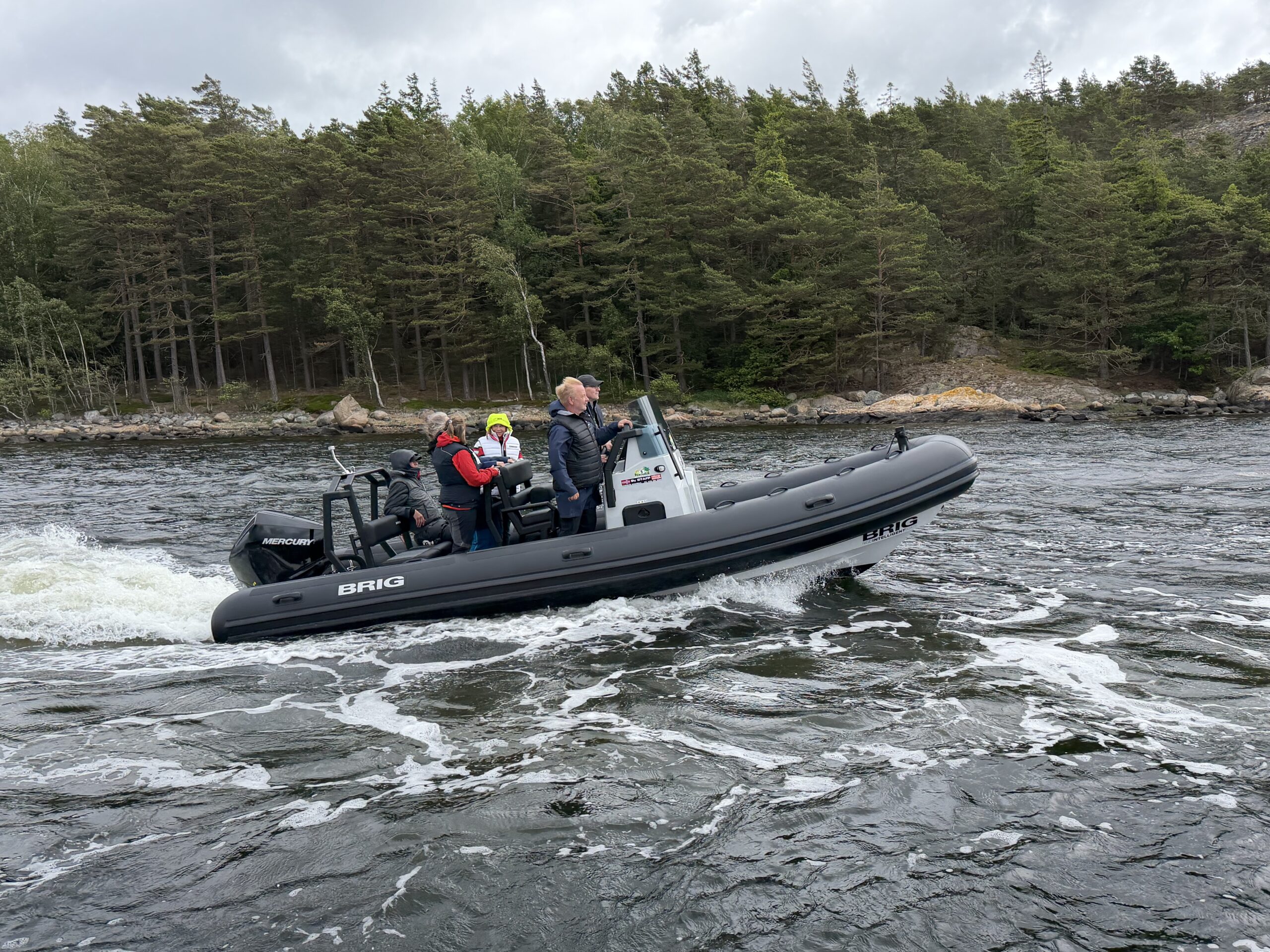
{Illustration: A BRIG RIB underway in moderate conditions, photographed from behind and to the side so the spray pattern is visible. Add a technical inset identifying the spray rail on the hull, using a verified manufacturer image or drawing where possible.}
4. How are chines, strakes and spray rails different?
These features can look similar when viewed from a distance, and their functions can overlap. The easiest way to distinguish them is to look at their shape and location.
| Feature | Typical form | Main influence |
|---|---|---|
| Chine | An edge or transition between hull surfaces | Hull geometry, water separation and aspects of handling |
| Strake | A longitudinal ridge or raised feature along the hull bottom | Water flow, lift and aspects of directional behaviour |
| Spray rail | A raised edge or projection that redirects water | Spray management, with possible additional hydrodynamic effects |
These are general descriptions rather than strict definitions for every hull. Some features combine functions, and manufacturers may use different terminology for similar shapes.
What matters is how each feature works within the complete design. Looking at a single ridge in isolation will not tell you everything about the boat’s ride or performance.
5. Why do these details matter when a RIB is underway?
A hull moving through the water is constantly responding to changing forces. Speed, trim, passenger distribution, fuel load and wave direction all affect how it behaves.
The chine influences the transition between the hull’s bottom and sides. Strakes help shape the flow of water beneath the hull, while spray rails can redirect water as it moves away from the boat. Their combined effect contributes to the way the hull generates lift, sheds water and responds to the water around it.
This is one reason two boats with similar dimensions and engine power can feel different underway. Their hull profiles may differ in ways that are difficult to appreciate from a photograph or a specification sheet.
It is also why an individual feature should not be judged by its appearance alone. A more pronounced ridge might be beneficial in one design but inappropriate in another. A spray rail’s effectiveness depends on where it sits and how the rest of the hull directs the water towards it.
Good hull design is about achieving a balance. The goal is to make the boat behave appropriately for its intended use, rather than maximise one characteristic at the expense of everything else.
6. Do these features make a boat faster?
They can contribute to performance, but none guarantees a higher top speed.
Strakes and other hull features influence how water moves beneath a planing boat and can affect lift and resistance. Chines and spray rails also influence the way water separates from the hull. The resulting performance depends on how these features interact with the hull’s overall shape, its weight and the conditions in which it operates.
Other factors remain equally important: engine power, propeller selection, trim, loading and the distribution of weight on board. A hull feature that benefits one operating condition may have a different effect at another speed or angle of trim.
It is therefore more useful to think in terms of the complete hull design than to search for one feature that promises speed. Designers are balancing acceleration, cruising efficiency, handling, comfort and predictable behaviour—not simply trying to make the boat reach the highest possible number on a speed display.
(Internal link: Inflatable? Yes. Sluggish? Absolutely Not: How a RIB Gets Its Speed)
[Chief Engineer interview suggestion: Ask which hull features have the most noticeable effect on the performance of a BRIG RIB, and how their benefits change between cruising speed and higher-speed operation.]
7. Can hull details improve comfort in waves?
Hull geometry has a significant influence on ride comfort, but the relationship is not as simple as it may first appear.
The V-shaped profile of a hull, its length and its weight distribution all affect how it meets waves. Chines, strakes and spray rails contribute to the way water flows around the hull and can influence aspects of its behaviour, but they cannot compensate for every design limitation or operating condition.
A boat may perform comfortably in one type of sea and respond differently when waves become steeper, approach from another direction or arrive at shorter intervals. Speed and trim also matter. Even a well-designed hull can deliver an uncomfortable ride if driven too fast for the conditions.
Spray management is one part of comfort, as water directed away from the cockpit can help keep passengers drier. The hull’s response to wave impacts is another matter, influenced by its geometry and how the boat is operated.
For prospective owners, this means that photographs and technical descriptions are useful starting points, but a sea trial can provide a much better sense of the boat’s real-world behaviour.
(Internal link: Why RIBs Ride So Well: Understanding the Deep-V Hull)
8. Can you see these features when choosing a RIB?
Sometimes. Depending on the boat’s design and how it is displayed, you may be able to see the chines and some of the strakes from the side or stern. Other features are easier to inspect when the boat is lifted out of the water.
However, visual inspection has its limits. A photograph may show the number of strakes, but not their precise geometry, the reasoning behind their placement or the way they interact with the rest of the hull.
When comparing boats, use hull details as a prompt for better questions rather than as a simple scoring system. Ask what the hull was designed to do, how it is expected to perform in the conditions you normally encounter and what the manufacturer recommends for loading and operation.
If possible, arrange a sea trial and pay attention to how the boat accelerates, turns, tracks and handles the conditions on the day. Consider these observations alongside the manufacturer’s specifications and guidance.
There is no need to become a naval architect to choose a good RIB. Understanding a few basic principles simply helps you ask more useful questions.
9. The design works as a whole
Chines, strakes and spray rails are small details within a much larger system. Their value comes from the way they complement the hull’s overall geometry, rather than from any one feature working in isolation.
A designer must consider the boat’s intended use, hull dimensions, weight distribution, engine installation and expected operating conditions. A recreational RIB intended for family cruising may have different priorities from a boat designed for professional work or higher-speed applications.
That is why it is difficult to judge a hull by counting its ridges or looking for the most dramatic profile. The best design is the one that achieves the right balance for the boat’s intended role.
Next time you see a RIB on a trailer or lifted out of the water, take a moment to look at the underside. The lines and edges are not just styling details. They are part of the engineering that determines how the boat interacts with the water—and how that interaction translates into the experience at the helm.