

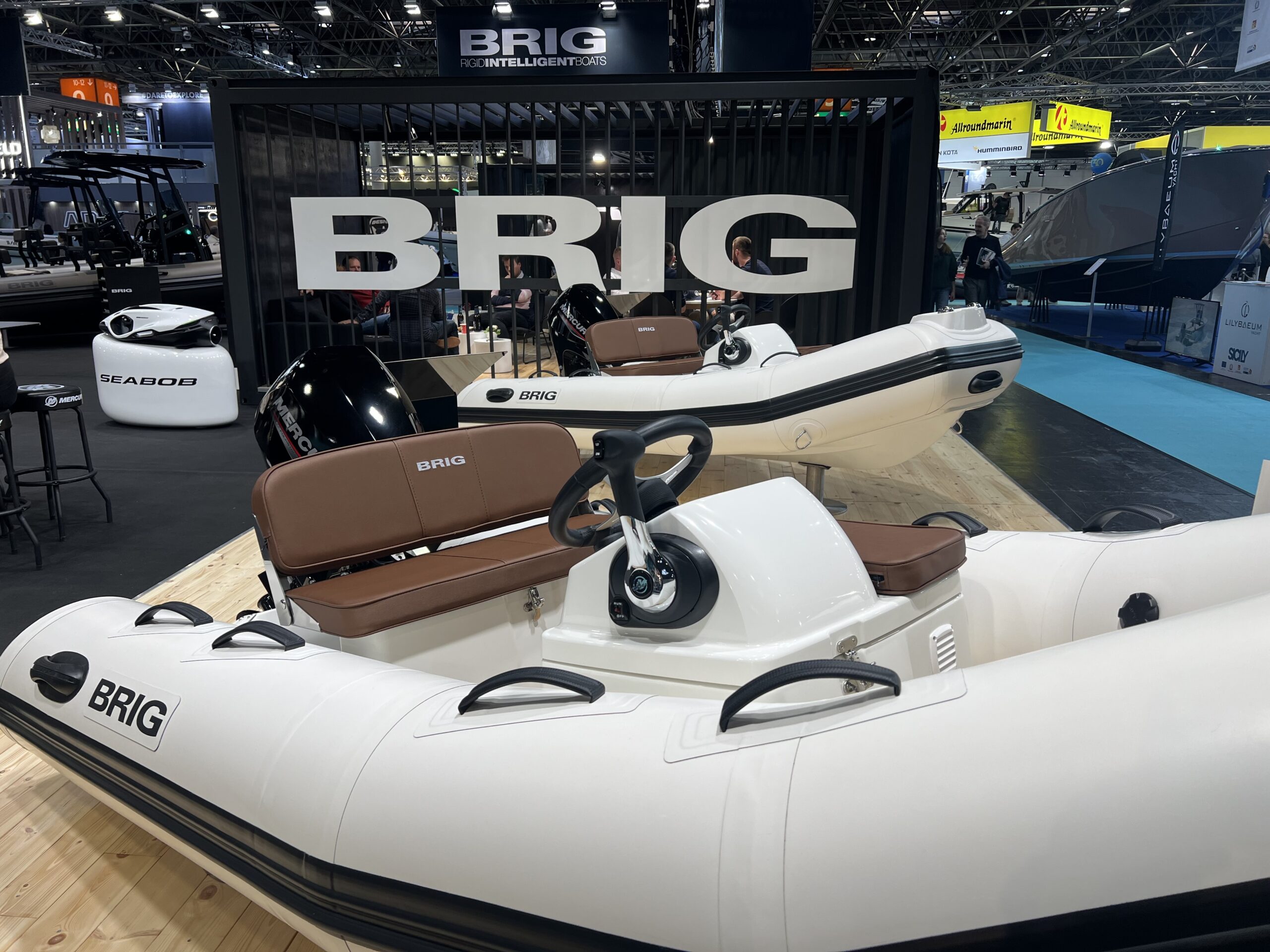

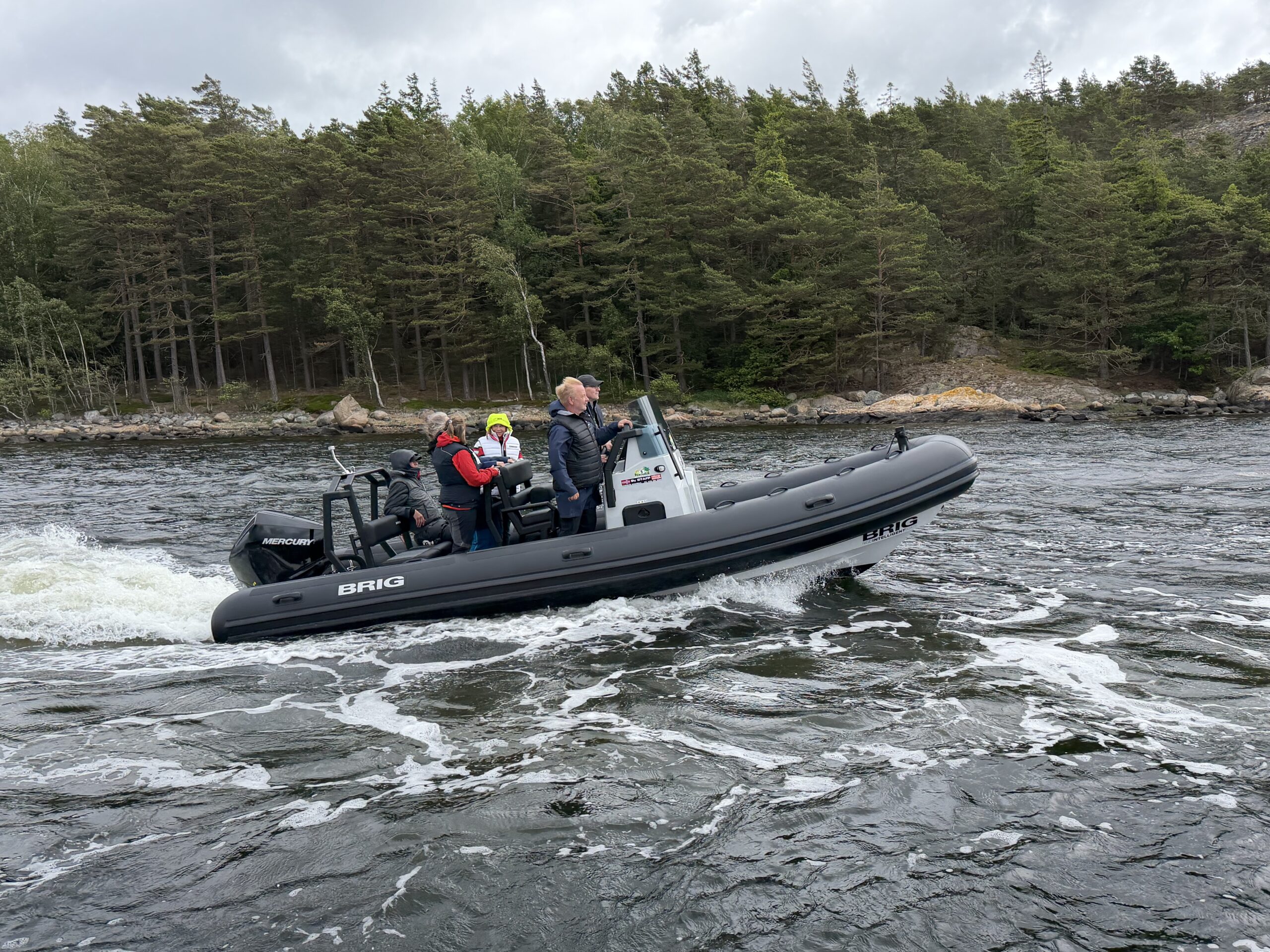



The inflatable tubes are among the most recognisable features of a RIB. They give the boat its distinctive shape, provide additional buoyancy and create a forgiving perimeter around the rigid hull. Yet despite their apparently simple appearance, they are carefully engineered structures made from multiple components.
A finished RIB tube is not simply a long piece of fabric filled with air. It is assembled from shaped panels of reinforced material, joined together using processes suited to the fabric, fitted with valves and other components, and divided into separate airtight chambers. Its shape, pressure and attachment to the hull all influence how it performs.
Understanding the basics of tube construction is useful when choosing a new RIB, evaluating a used one or simply looking after a boat you already own. It also helps explain why the quality of the finished product depends on much more than the material named in the brochure.
More than a piece of inflatable fabric
A RIB’s tubes form a substantial part of the boat’s structure and appearance, but they have a different role from the rigid hull beneath them.
The hull provides the main underwater geometry, while the inflatable collar contributes buoyancy and creates a soft perimeter around the boat. Depending on the design and operating conditions, the tubes may also interact with the water and influence aspects of stability and handling.
The collar is usually made from several shaped fabric panels rather than one continuous piece. These panels are cut and assembled to create the required diameter, curvature and overall form.
The design must account for the boat’s dimensions, the shape of the bow and stern, the location of the hull attachment points and the fittings that will be installed. It must also accommodate the pressure needed to maintain the intended tube shape.
The result may look straightforward from the outside, but its construction involves material selection, pattern development, joining processes and careful quality control.
1. The fabric: strength and airtightness working together
The starting point is a reinforced marine fabric.
Most modern RIB tubes use a woven textile reinforcement, commonly polyester, combined with polymer coatings. The textile provides much of the fabric’s tensile strength, while the coatings contribute airtightness, surface protection and the properties needed for manufacturing and use.
Two widely used material families are PVC-based fabrics and CSM-based fabrics, commonly known by the familiar Hypalon name.
PVC-based materials are generally thermoplastic, which allows suitable fabrics to be joined using welding processes. CSM-based materials are elastomeric and are generally assembled using compatible adhesive systems.
The fabric’s performance depends on more than the basic polymer. Its reinforcement, coating formulation, thickness, mass per square metre and resistance to environmental exposure all contribute to the finished tube’s characteristics.
For this reason, two fabrics described simply as PVC may have different properties, just as two CSM-based fabrics may differ in construction and intended use.
A manufacturer’s choice of fabric should reflect the tube design, the production process and the conditions in which the boat is expected to operate.
(Internal link: PVC vs CSM/Hypalon: Which RIB Tube Material Is Right for You?)
{Illustration: A simple layered cross-section of reinforced marine tube fabric, identifying the textile reinforcement and protective/airtight coatings. The diagram should be generic unless based on a verified fabric manufacturer’s technical specification.}
2. From flat panels to a three-dimensional tube
A finished tube has curves, tapered sections and changes in diameter that cannot be produced accurately by simply rolling a rectangular sheet of fabric into a cylinder.
Manufacturers develop patterns for the individual panels, taking account of the desired tube geometry and the way the material behaves during assembly and inflation.
The panels are then cut using methods appropriate to the fabric and production system. Accurate cutting matters because small differences in panel shape can affect alignment, seam geometry and the finished collar.
Once the panels are prepared, they are joined to create the tube’s three-dimensional form. The bow may require particularly careful patterning, as the collar curves around the front of the boat and often changes shape along its length.
The position of fittings, handles, rubbing strakes and attachment components must also be planned before final assembly.
This stage is a useful reminder that tube manufacture combines design and practical craftsmanship. Even with modern cutting and production equipment, the accuracy of the patterns and the consistency of assembly remain important.
{Illustration: A three-part production sequence showing flat fabric panels, partially assembled tube sections and the completed inflated collar. Use genuine BRIG production images if available.}
3. How tube seams are made
The seams are among the most important parts of an inflatable tube because they join the individual fabric panels into an airtight structure.
Different materials require different joining processes.
PVC-based fabrics can often be joined using thermal welding, including hot-air or high-frequency welding, depending on the specific fabric and production equipment. These processes use controlled heat or electromagnetic energy, together with pressure, to form a bond between compatible material surfaces.
CSM-based fabrics are generally joined using adhesive bonding. This requires suitable adhesives, careful surface preparation and controlled application and curing procedures.
Both approaches can produce durable seams when the materials and processes are correctly matched. Neither should be judged solely by whether it is described as welded or glued.
The geometry of the seam also matters. Overlap dimensions, alignment, reinforcement and the way loads are transferred between panels influence the finished construction.
For owners, the most important consideration is that the seams are manufactured to the required standard and inspected appropriately.
A seam should not be evaluated only by its appearance. Its strength and airtightness depend on the materials, process and quality control behind it.
{Illustration: A clear technical comparison of a welded PVC seam and an adhesive-bonded CSM seam, using verified production photographs or manufacturer diagrams. Avoid generic illustrations that imply a single seam construction is used by all manufacturers.}
4. Why RIB tubes have separate air chambers
One of the most important features of a modern RIB collar is that it is divided into multiple airtight compartments.
Rather than relying on one continuous air volume, the tube contains internal partitions, often called bulkheads, that separate it into individual chambers.
This arrangement provides redundancy. If one chamber loses pressure because of damage or a faulty valve, the remaining chambers can retain air, helping preserve part of the collar’s buoyancy.
The number and arrangement of chambers depend on the boat’s design and size. Manufacturers determine their configuration according to the intended application and relevant design requirements.
It is important not to interpret multiple chambers as a guarantee that a damaged boat can always continue operating normally. A significant loss of pressure can affect the collar’s shape, buoyancy and the boat’s behaviour. The appropriate response depends on the damage, conditions and manufacturer’s instructions.
Nevertheless, separate chambers are an important part of modern inflatable-tube construction and contribute to the practical resilience of the design.
{Illustration: A simplified top-view diagram of a RIB collar showing several independent air chambers separated by internal bulkheads. Label the chamber boundaries and valves. Use the actual chamber arrangement only if verified for the model shown.}
5. Bulkheads: the partitions inside the tubes
The internal partitions that divide the collar into chambers are usually made from compatible reinforced fabric and joined to the tube structure.
Their role is to maintain separation between the air volumes while accommodating the shape and pressure of the surrounding tube.
Because the chambers are adjacent, differences in pressure can place loads on the bulkheads. This is one reason manufacturers provide specific inflation procedures and pressure recommendations.
Inflating one chamber substantially more than its neighbours may create pressure differences that the internal partitions were not intended to experience during normal use.
The correct procedure depends on the tube design. Some manufacturers recommend bringing all chambers up to pressure gradually and evenly, while others specify a particular sequence.
Owners should follow the instructions for their own boat rather than assume that one method applies to every RIB.
Bulkheads are not normally visible from outside the tube, but their construction and attachment are important aspects of the collar’s overall integrity.
6. Valves: small components with an essential job
Every inflatable chamber needs a way to be inflated, checked and, when necessary, deflated.
This is the role of the inflation valve.
A typical marine inflation valve includes a sealing mechanism designed to retain air while allowing controlled inflation and deflation. Its exact construction varies between manufacturers and valve systems.
Valves must be installed securely in the fabric and remain accessible for normal use. Their seals and fittings also need to remain in suitable condition.
A valve that is contaminated, damaged or incorrectly closed can contribute to pressure loss. Before assuming that a tube has a puncture, it is worth checking the valve according to the manufacturer’s instructions.
Some tube systems may also incorporate pressure-relief arrangements, depending on the design. These should not be assumed to be present on every RIB, and they do not replace correct inflation and pressure monitoring.
Valves may be small compared with the rest of the collar, but their reliability is essential to maintaining the intended pressure.
7. Tube pressure: why the correct amount matters
An inflatable tube needs sufficient internal pressure to maintain its intended shape and structural behaviour.
Too little pressure can allow the collar to deform more than intended. This may affect the way it supports loads, interacts with the water or retains its designed geometry.
Excessive pressure can place unnecessary loads on the fabric, seams, valves and internal partitions.
The correct operating pressure is specified by the manufacturer and may vary between tube designs and materials. It should be measured using a suitable pressure gauge rather than estimated by pressing the tube with a hand.
One of the most important things to understand is that pressure changes with temperature.
Air inside the tube expands as its temperature rises, increasing pressure when the tube’s volume remains approximately constant. When the temperature falls, the pressure decreases.
This means a tube inflated in the cool morning may have a higher pressure after spending several hours in strong sunlight. Similarly, a tube that feels firm in the afternoon may become noticeably softer when the temperature drops.
For an ideal gas at constant volume, pressure is proportional to absolute temperature. Real RIB tubes are flexible, so their volume can change and the relationship is not perfectly constant-volume, but the basic principle remains useful.
Owners should check pressure in accordance with the manufacturer’s guidance and avoid exceeding the stated limits.
{Illustration: A simple diagram showing how tube pressure can change between cool morning conditions and strong midday sunlight. Include a clear note that the values and adjustment procedures are model-specific.}
8. How the tubes are attached to the hull
The collar must be securely connected to the rigid hull, and the attachment system is an important part of the overall design.
Different manufacturers use different arrangements. Depending on the boat, the collar may be bonded to the hull, attached through a mechanical system or installed using a combination of methods.
The attachment must accommodate the geometry of the hull and collar while transferring the loads that occur during normal operation.
Its design also influences serviceability. Some tube systems are intended to be removable or replaceable using specialised procedures, while others are more permanently integrated into the boat’s construction.
There is no universal attachment method that suits every RIB. The appropriate solution depends on the hull design, tube construction and intended application.
When evaluating a boat, it is useful to ask how the collar is attached, what inspection is recommended and what service options are available if the tubes eventually require major repair or replacement.
{Illustration: A verified close-up or cross-sectional drawing of a RIB tube-to-hull attachment. Use a BRIG-specific illustration only after confirming the actual construction method with the production team.}
9. The details added after the main tube is assembled
A completed inflatable collar includes more than fabric panels and valves.
Depending on the model, it may incorporate rubbing strakes, handles, attachment patches, decorative elements and other fittings.
Rubbing strakes are particularly useful because they provide a protective surface along areas of the tube that may come into contact with pontoons, other boats or equipment. Their design and position vary according to the intended use of the RIB.
Handles and other fittings must be attached in a way that is compatible with the tube material and the loads they are designed to carry.
Not every handle or attachment point is intended for lifting the boat, towing or securing heavy equipment. Owners should use only the fittings designated by the manufacturer for those purposes.
The placement of these components also affects appearance and everyday practicality. A well-designed collar should integrate them without unnecessarily interfering with boarding, movement or maintenance.
10. How are RIB tubes tested?
Quality control is an essential part of tube manufacture.
A completed collar must retain air at its specified operating pressure and meet the manufacturer’s requirements for construction and assembly. The exact inspection and testing procedures depend on the manufacturer, materials and applicable standards.
Testing may include pressure-retention checks, visual inspection of seams and fittings, and examination of the completed tube before or after installation.
A pressure-retention test can help identify leaks, but the interpretation of results must account for temperature changes. A reduction in measured pressure does not necessarily indicate a leak if the air inside the tube has cooled.
Manufacturers may also use additional material, seam or production-process tests as part of their quality-control systems.
For buyers, the relevant questions are whether the tubes are manufactured using suitable processes, whether the finished product is inspected and what warranty and service support are provided.
[BRIG production specialist interview suggestion: Ask the tube-production team to describe the actual quality-control sequence used at BRIG, including how pressure retention and seam integrity are checked. Include specific procedures only after they have been verified.]
11. What does tube construction mean for everyday ownership?
Most owners will never need to think about fabric patterns, internal bulkheads or seam geometry during normal use. But understanding how the collar is made helps explain why a few simple habits matter.
Correct inflation is important because pressure affects the tube’s shape and the loads on its components. Regular inspection helps identify damage, abrasion or unusual pressure loss before it develops into a larger problem.
Cleaning and storage should follow the recommendations for the specific tube material. Repairs should use compatible materials and procedures, particularly when damage involves seams, valves or attachment points.
It is also worth remembering that tubes are serviceable components. Their condition depends on age, exposure, use and maintenance, and they may eventually require professional repair or replacement.
A well-made tube is designed to provide reliable service, but its long-term condition is influenced by how the boat is used and cared for.
The engineering behind a familiar shape
From the outside, a RIB’s collar may look like a relatively simple inflatable structure. In reality, it is the result of carefully selected materials, accurately shaped panels, suitable joining processes, internal chambers, valves and a secure connection to the rigid hull.
Each element contributes to the finished tube’s ability to retain its shape, provide buoyancy and withstand the demands of normal marine use.
For someone choosing a RIB, the lesson is straightforward: look beyond the material name. Ask about the construction, the manufacturer’s quality-control procedures, the recommended operating pressure and the availability of service and repair support.
The tubes may be the most recognisable part of a RIB, but their value lies in the engineering that makes them work reliably as part of the complete boat.