



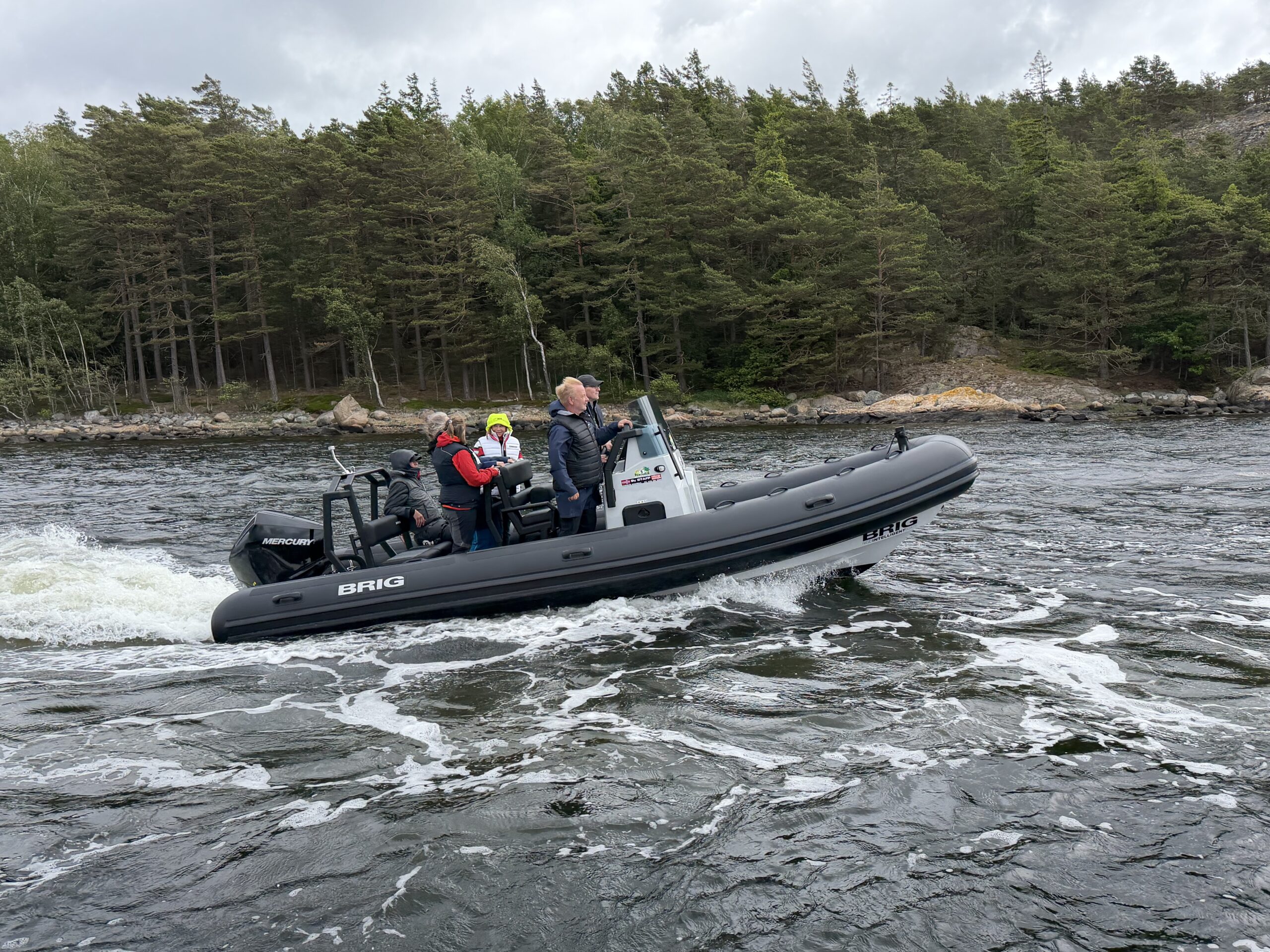



Radar is one of those marine technologies that can make a boat’s helm look impressively capable. A rotating or enclosed antenna, a dedicated display and the ability to detect objects beyond what the eye can easily distinguish all suggest serious navigation equipment.
But does a recreational RIB really need radar?
For many owners, the answer is no. Their boating takes place during daylight, in familiar coastal waters and in conditions where good visibility is part of the plan.
For others, radar can provide a valuable additional source of information, particularly during longer passages or in regions where fog and reduced visibility are realistic concerns.
The important question is not whether radar is advanced technology. It is whether it addresses a genuine requirement in the way you use your boat.
What does marine radar actually do?
Marine radar transmits radio-frequency signals and processes the reflections returned from objects in its surroundings.
Depending on the system and conditions, it may detect land features, vessels, navigation structures and other targets.
The resulting information is displayed in a form that helps the operator understand the relative position and movement of detected objects.
Radar can be especially useful when visibility is reduced, but it has limitations.
Small, low-profile or poorly reflecting objects may be difficult to detect. Sea clutter, rain and other conditions can affect the display.
A radar image must be interpreted rather than treated as a complete picture of everything around the boat.
When radar becomes valuable
Radar is most relevant when a RIB is used in conditions or locations where visual navigation may be restricted.
Frequent fog, longer coastal passages, early departures or operation in busy waters may make radar worth considering.
It can also provide useful information when navigating near land or other vessels under suitable circumstances.
However, radar does not make poor weather or restricted visibility inherently safe.
Safe speed, proper lookout, navigation skills and compliance with applicable collision-prevention rules remain essential.
Radar versus AIS
Radar and AIS are sometimes discussed as alternatives, but they provide different information.
AIS receives or exchanges transmitted vessel information from suitably equipped stations.
Radar detects certain physical targets through reflected signals, whether or not those targets carry AIS.
Not every vessel transmits AIS, and not every target will be reliably detected by radar.
AIS information can also be incomplete, delayed or inaccurate.
Used appropriately, the systems can complement one another, but neither replaces a proper lookout.
Can radar fit on a small RIB?
Compact solid-state radar systems have made installation possible on a wider range of recreational boats.
Nevertheless, a RIB’s console and superstructure may impose practical limits.
The antenna requires an appropriate mounting position, clear operating geometry and compliance with manufacturer instructions concerning separation, structural support and electromagnetic exposure.
A T-top or arch is not automatically suitable for radar installation.
The installation must account for weight, vibration, wiring, electrical power and the effect on other equipment.
For smaller RIBs, these requirements may outweigh the benefits.
{Illustration: A simplified RIB profile showing a radar antenna’s mounting position and general field of view. Any separation distances must come from the specific manufacturer’s installation instructions.}
What about power consumption?
Modern radar equipment varies considerably in electrical demand.
The total load includes the radar unit, display and any supporting electronics.
On a RIB with a relatively small battery system, this deserves attention.
Before installation, consider the available charging capacity, expected operating duration and other electrical loads.
A radar system should not compromise the power available for essential equipment or engine starting.
(Internal link: 12V, Batteries and Power Management on a RIB.)
Learning to interpret radar
Radar is not a substitute for experience.
The operator must understand display orientation, range settings, gain, clutter suppression and the interpretation of target movement.
A poorly adjusted radar may conceal useful information or create misleading impressions.
Training is particularly important for owners who intend to use radar during reduced visibility.
Simply switching it on and seeing targets appear is not enough.
Is radar worth the investment?
For a RIB used mainly for fair-weather family outings, radar may add cost and complexity without providing much everyday benefit.
For owners who regularly travel in regions affected by fog or undertake more demanding passages, it may be a worthwhile addition.
The decision should be based on realistic operating conditions and the skipper’s willingness to learn the system.
A carefully chosen radar installation can be valuable. An expensive radar that nobody knows how to use is considerably less so.