



The RIB Speed Performance Explained

There are two kinds of people who see a RIB for the first time. The first looks at it and thinks:
“That’s going to be fun.”
The second looks at the tubes and thinks:
“That’s going to be slow.”
The second person is about to be surprised. The word inflatable has done an extraordinary amount of reputational damage over the years. It conjures images of small boats with soft floors, tiny outboards and a speed that can best be described as “eventually”. A modern RIB is a completely different animal. The inflatable part is important. But the rigid hull is where the speed happens.
And once you understand how the two work together, the performance of a good RIB stops being surprising and starts being rather logical.
(Internal link: What Is a RIB? A Simple Guide to Rigid Inflatable Boats)
Let’s get the obvious question out of the way
Are RIBs fast?
Yes. Very fast, depending on the boat, engine, load and conditions.
BRIG’s current range spans everything from compact tenders to large performance-oriented cruisers. The Eagle 6, for example, is rated for up to 150 hp, while the Eagle 10 can accommodate up to 700 hp in a twin-engine configuration and is described by BRIG as capable of speeds around 50 knots in the appropriate setup. (brigboats.com)
But horsepower alone doesn’t make a boat fast. If it did, we’d simply bolt a ridiculous engine onto everything and retire the naval architects. Unfortunately for our shortcut, hull design matters enormously.
The secret is the bit underneath you
When a RIB is sitting at the dock, the tubes are impossible to miss. They’re big. They’re colourful. They are usually the first thing people notice. But once the boat gets moving, the rigid hull becomes the star of the show.
A planing RIB uses its hull’s underwater geometry to generate dynamic lift and reduce the amount of hull sitting deeply in the water. The result is a boat that can accelerate onto the plane and then skim across the surface rather than simply pushing a large volume of water out of the way.
That’s the fundamental difference between displacement speed and planing performance.
{Simple two-panel technical illustration. Left panel: RIB at displacement speed, with the hull sitting deeper in the water and a large volume of water being displaced. Right panel: RIB on plane, with the bow slightly elevated, a smaller portion of the hull in contact with the water and clear water flow beneath the running surface. Label “Displacement mode” and “Planing mode”. Avoid implying that the tubes necessarily leave the water completely.}
What actually happens when you open the throttle?
At rest, the boat is supported primarily by buoyancy. Start accelerating and the hull begins to move through the water. Water flowing underneath the hull creates hydrodynamic forces.
As speed builds, the hull generates increasing dynamic lift. The boat rises. Its running attitude changes. The wetted area can decrease. Drag characteristics change.
And eventually you reach the familiar moment when the bow rises, the engine note changes and the boat suddenly feels as if someone has taken the brakes off.
That’s getting onto the plane.
The exact process varies enormously with hull shape, weight, trim, propeller, engine power and loading. But the basic principle is universal:
A planing boat uses speed to create lift.
And a well-designed RIB is very good at exploiting that principle.
(Internal link: Why RIBs Ride So Well: Understanding the Deep-V Hull)
So where do the tubes go?
This is where the old “inflatable = drag” argument gets a little confused. The tubes are obviously part of the boat’s interaction with the water. Their exact wetted area varies with hull design, speed, loading and trim.
They are not magical anti-drag devices. But neither are they simply giant rubber brakes. A RIB’s performance comes from designing the hull and tube geometry as one system. The tubes provide buoyancy, stability and a protective perimeter. The hull provides the primary planing surface. The transition between those elements is carefully designed. And different RIBs make different choices depending on what they’re supposed to do.
BRIG’s Eagle 6.7 is a useful example: its specifications describe a redesigned deep-V hull and a slightly higher tube position, with BRIG specifically connecting that configuration to speed, responsiveness and fuel efficiency. That is a much more interesting answer than simply saying:
“It’s an inflatable, but fast.”
Weight is the other half of the equation
Here’s a less glamorous but extremely important ingredient:
weight.
Every kilogram on a boat has to be accelerated. It has to be supported. It has to be pushed through the water. And it has to be carried back home. That’s why power-to-weight ratio matters so much. Take the current Eagle range.
The Eagle 6 has an empty-boat weight of around 550 kg and a maximum rated power of 150 hp. The Eagle 6.7 is larger and substantially heavier at around 810 kg, with maximum power of 225 hp.
Those numbers tell a story. The bigger boat needs more power not simply because it’s longer, but because it has more mass to move and more boat to support. A good RIB therefore isn’t just a lightweight boat. It is a boat where weight, hull geometry and available power have been considered together.
(Internal link: Why RIB Weight Matters More Than You Think)
This is why under-powering a boat can be frustrating
There is a temptation when buying a new boat to think: “Why would I buy the bigger engine? The smaller one will save money.” Sometimes it will. But the cheapest engine on the specification sheet isn’t necessarily the most economical choice in real life.
If a boat is heavily loaded and underpowered, it may struggle to reach its intended operating range. You may spend more time accelerating. You may need more throttle to maintain speed. And the boat may never behave the way the designer intended it to. The answer isn’t automatically “buy the biggest engine”. It is:
Choose an engine appropriate to the boat, load and intended use.
And follow the manufacturer’s recommended and maximum power limits.
BRIG’s Eagle 6.7, for example, lists 175–200 hp as recommended power and 225 hp as the maximum. That’s a useful distinction. Maximum power is not necessarily the same thing as ideal power.
(Internal link: How to Choose the Right Outboard for Your RIB)
What does a deep-V have to do with speed?
Quite a lot. A deep-V isn’t simply there to make the ride softer. It is part of the hull’s hydrodynamic character. The angle and shape of the running surface influence how the boat interacts with the water, particularly as speed and sea state increase.
A well-designed deep-V can allow a RIB to maintain control and comfort at speeds where a flatter hull might become increasingly uncomfortable.
But, again, there is no free lunch. A deep-V can require more power to achieve the same planing performance as a flatter hull. The designer is balancing:
Ride quality
Handling
Stability
Efficiency
Acceleration
Top speed
And then trying to make all of those things coexist peacefully. Which is considerably harder than making one of them excellent.
(Internal link: Deep-V Hulls Explained)
The magic word is “trim”
Once the boat is on plane, the relationship between the hull and the water can be adjusted. That is where trim becomes important. The outboard’s trim angle changes the engine’s thrust direction relative to the hull. This influences the boat’s running attitude.
Too much bow-down attitude can increase wetted area and drag. Too much bow-up attitude can reduce control, increase sensitivity and potentially make the boat uncomfortable or inefficient.
The ideal position depends on speed, sea state, load and boat. Experienced drivers often learn to feel it. They don’t necessarily think: “Ah yes, approximately 4.7 degrees of trim.” They think: “That’s better.”
Boat driving is occasionally a very technical science conducted entirely by instinct.
Why do RIBs accelerate so well?
Several things can help. Low relative weight. Efficient hull geometry. Adequate power. A deep-V running surface. And a hull designed to transition onto the plane without excessive resistance. But acceleration isn’t simply about getting from zero to maximum speed.
For many owners, getting onto the plane quickly is much more useful than having a heroic top-speed number. A family boat loaded with people, fuel, coolers, water toys and an optimistic amount of luggage needs to get onto plane without an extended negotiation with the ocean.
That is why the power-to-weight relationship and hull efficiency matter so much.
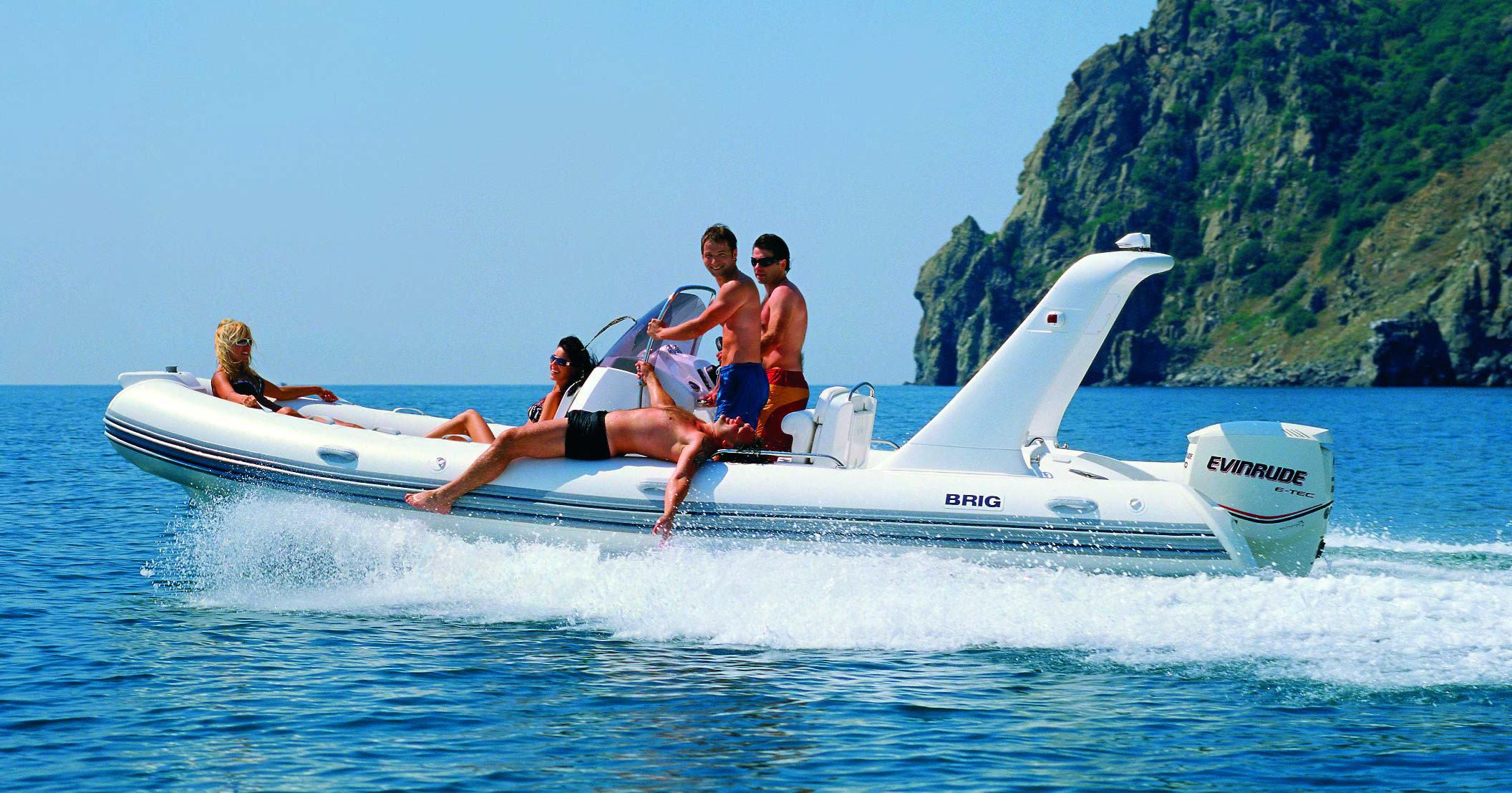
{Photograph of a BRIG with a realistic family load accelerating onto plane. Show several passengers naturally seated, with the bow lifting slightly and the stern wake beginning to form. Avoid a dramatic “launch”; the image should communicate effortless acceleration under a normal real-world load.}
And then there’s fuel economy
This is where the performance story becomes more interesting. Speed and efficiency are not necessarily enemies. A boat that gets onto plane efficiently and can maintain its cruising speed without excessive throttle can be more economical than one that is constantly struggling to stay on plane. The ideal cruising point depends on the hull, engine, propeller, load, sea state and desired speed. That’s why quoting one magical “fuel consumption” figure for a boat can be misleading.
Change the passenger count. Add a full fuel tank. Put five dive cylinders on board. Drive into a head sea. Trim differently. Suddenly you’re testing a different boat. Good boat design gives you a useful operating envelope. Good seamanship means learning where that envelope is.
(Internal link: How to Find the Most Efficient Cruising Speed for Your RIB)
What about top speed?
Top speed is fun. There, we said it. There is something deeply satisfying about seeing a number on the GPS climb. But top speed is only one measure of performance.
A RIB that reaches 50 knots but becomes unpleasant at 35 is arguably less useful than one that is comfortable, predictable and efficient at 30–40.
Performance should include:
- acceleration
- cruising speed
- fuel efficiency
- handling
- stability
- ride quality
- directional control
- behaviour in waves
A boat is not a speedometer with upholstery attached.
[Ask BRIG Chief Engineer: “When BRIG engineers test a new hull, which performance characteristic matters most to you that customers never see in the brochure?”]
That answer would make an excellent quote.
Why a fast RIB can still feel comfortable
This is one of the category’s great advantages. Speed doesn’t automatically have to mean discomfort.
The combination of a rigid deep-V hull, buoyant tubes and carefully designed geometry can produce a boat that remains composed at speed.
BRIG describes the Eagle 6, for example, as using a reinforced deep-V hull, extended waterline, extra-wide tubes and a square bow to produce a stable and dry ride.
The Eagle 6.7 takes a different approach, with its redesigned deep-V and higher tube position intended to improve seaworthiness, handling, stability and efficiency. This illustrates an important point:
There isn’t one “BRIG hull shape”.
The engineering evolves with the size and purpose of the boat.
The larger BRIGs take the idea much further
At the upper end of the range, the relationship between weight, hull and power becomes even more interesting.
The Eagle 8, for example, is listed at 7.98 metres, around 1,260 kg empty, with a maximum power rating of 350 hp. The Eagle 10 stretches to 10.3 metres and is rated for up to 700 hp with twin engines.
That is a very different proposition from a 4-metre tender. Yet the underlying principle is the same.
Make the hull work efficiently with the power available.
The larger boat simply gives the designer more length, beam and payload to work with. And the owner more room to bring friends. Which is generally where the trouble starts.
The “inflatable boat” misconception
So let’s return to that original image. The little rubber dinghy. Soft floor. Tiny outboard. Three people going nowhere particularly quickly. That is an inflatable boat.
A RIB is something else. It is a rigid planing hull combined with an inflatable buoyancy collar. The inflatable collar is one of the reasons the design is so stable and versatile. The rigid hull is one of the reasons it can be so fast. And the fact that both are engineered together is the reason the whole thing works.
Calling a modern performance RIB “an inflatable boat” is technically correct. In roughly the same way that calling a modern sports car “a vehicle with four wheels” is technically correct.
It doesn’t tell you very much.
So how fast should your RIB be?
That’s a better question than:
“What’s its top speed?”
Ask instead: Where will you use it? How many people will normally be aboard? How much equipment will you carry? How rough is the water? How far do you travel? Do you want relaxed cruising, watersports, fishing, island hopping or long coastal passages? Do you want a boat that feels exciting at 40 knots, or one that feels effortless at 25?
Because the fastest boat isn’t necessarily the best boat. The best boat is the one whose performance matches your life on the water.
(Internal link: How to Choose the Right RIB for Your Lifestyle)
And yes, you can have some fun
There is absolutely nothing wrong with choosing a boat because it makes you grin. You open the throttle. The bow rises. The hull finds its running attitude. The wake stretches behind you. The tubes hold their position around the hull. The steering becomes light and responsive. And suddenly the person who asked:
“But isn’t it inflatable?”
is sitting beside you asking:
“How fast is it going?”
That’s usually the moment when the explanation can stop.
The boat has made the argument for you.
(Internal link: Explore the BRIG Eagle Range)
(Internal link: Explore the BRIG Navigator Range)
(Internal link: Find Your BRIG)