

Why RIBs Ride So Well? Deep V hull explained.
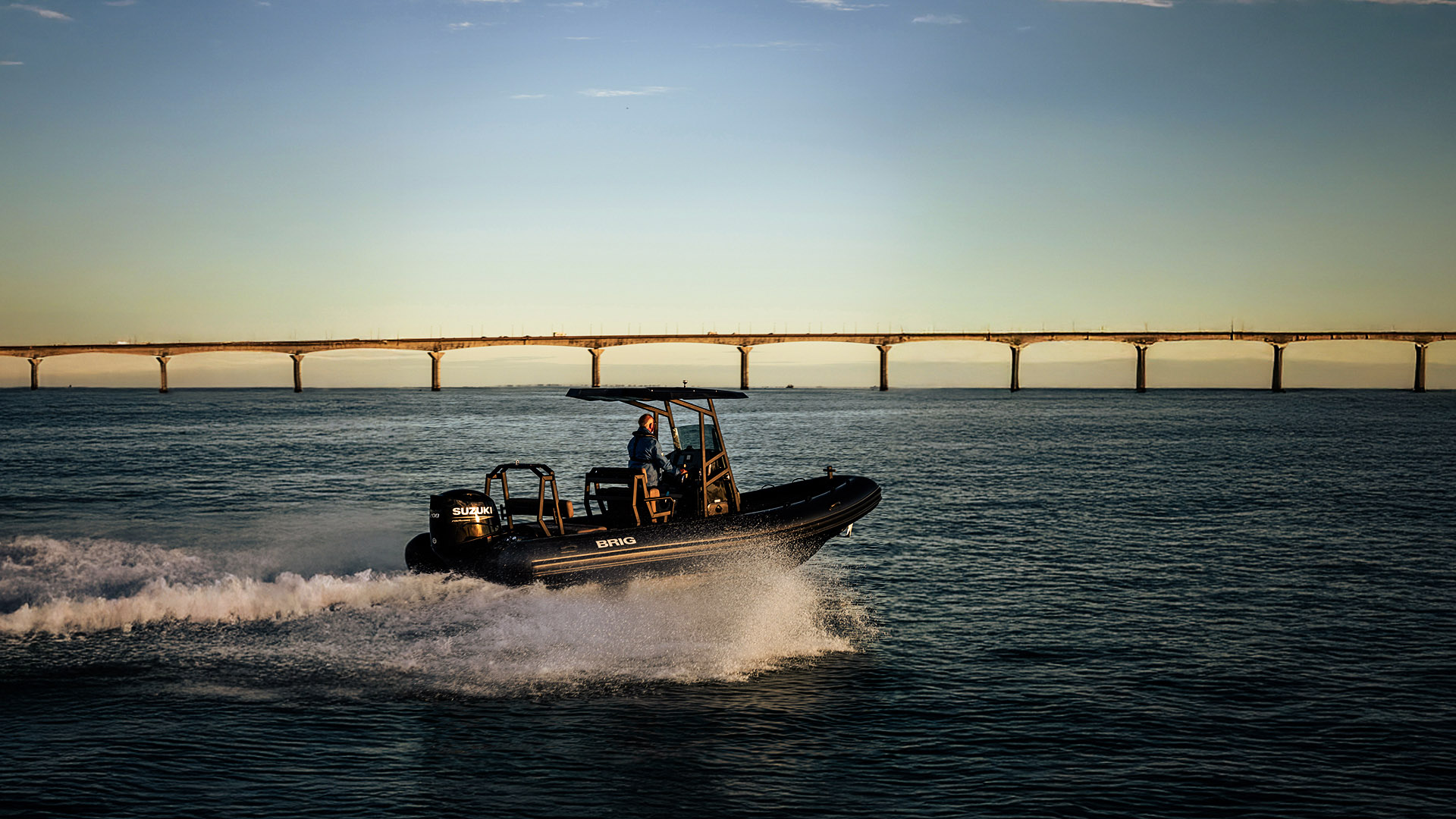
There is a particular moment when a boat stops merely moving through the water and starts making you wonder what is going on underneath it.
You hit a patch of chop. The bow rises. The hull meets the next wave. There is a brief whoosh rather than a thump.
And you think:
Ah. Someone has done their homework.
That feeling has a lot to do with hull design. And for many modern RIBs, one of the most important pieces of that design is the deep-V hull.
It sounds like something that should require a whiteboard, three engineers and a suspicious amount of coffee. Fortunately, the basic idea is rather easier to understand.
What does “deep-V” actually mean?
Look at a boat from the front or rear and you can see the shape of its hull bottom. A flat-bottomed boat is, unsurprisingly, fairly flat. A V-hull forms an angle.
A deep-V takes that V further, creating a relatively pronounced angle between the two sides of the hull bottom.
That angle is commonly described using deadrise — the angle between the hull bottom and the horizontal plane, normally measured at a specified location such as the transom. A deep-V is generally associated with relatively high deadrise, although there is no single magic number that suddenly transforms an ordinary hull into a “deep-V”.
And that matters because the angle at which the hull meets the water changes the way the boat interacts with waves.
{Simple technical illustration showing three hull cross-sections side by side: flat-bottom, moderate-V and deep-V. Label only the hull shape and approximate deadrise angle. Use the same width and waterline for all three so the visual comparison is immediately obvious. Clean BRIG editorial infographic style, no unnecessary engineering notation.}
Why does a deeper V help in waves?
Imagine taking a flat board and dropping it onto the surface of the water. Not particularly elegant. Now imagine taking the same board and tilting it so that one edge meets the water first.
The contact becomes more progressive. A V-shaped hull does something broadly similar. Instead of presenting a broad, relatively flat surface to an incoming wave, the angled hull can enter the wave more gradually.
This is one reason deep-V hulls are associated with softer rides in chop. It is not because the hull somehow makes waves disappear. It simply changes how the boat meets them. And that distinction matters.
A deep-V does not guarantee a comfortable ride in every condition. Hull geometry is only one part of the equation. Speed, weight, trim, loading, wave shape, beam, hull length and the rest of the boat’s design all contribute to what happens next.
(Internal link: What Is a RIB? A Simple Guide to Rigid Inflatable Boats)
Deadrise: the number hiding inside the V
You will often see the word deadrise in boat specifications. It is one of those terms that sounds considerably more complicated than it is. At its simplest, deadrise describes the angle of the hull bottom. More deadrise generally means a deeper V. Less deadrise means a flatter hull.
But don’t make the mistake of looking at one number and deciding which boat is “better”.A boat designer isn’t trying to win the Deepest V competition.
There is a trade-off. A deeper V can help the boat deal with waves more comfortably, but it can also influence stability, efficiency, power requirements and behaviour at rest.
A flatter hull can provide a very stable platform and may be efficient in certain conditions, but it can produce a harsher ride when faced with steep chop. The clever bit is finding the balance appropriate to the boat’s intended job.
As Discover Boating puts it, deadrise is only one of several important hull characteristics and needs to be considered alongside the rest of the design.
Which is why comparing two boats by deadrise alone is a little like choosing a car by tyre width. Interesting. Not enough.
What happens when a RIB gets onto the plane?
This is where things become particularly interesting. At low speeds, a RIB is primarily supported by buoyancy. As speed increases, the hull begins to generate dynamic lift. The boat rises higher in the water and transitions into planing.
The exact behaviour depends on the hull design, weight, trim and power available, but the general principle is simple:
At speed, the hull isn’t just floating. It is actively working with the water.
The shape of the running surface determines how efficiently that happens. This is one reason the underwater part of a RIB deserves at least as much attention as the seats, console and upholstery. The latter are what you notice while standing still. The hull is what you notice when the weather decides to become interesting.
{Side-profile technical illustration of a planing RIB at low speed versus on plane. Show the approximate waterline in each case, the hull attitude and the direction of water flow. Keep the graphic conceptual rather than mathematically precise. Caption: “At speed, the hull develops dynamic lift and changes its running attitude.”}
But what about the tubes?
This is where RIBs become particularly clever. The tubes and hull aren’t competing with one another. They have different jobs. The rigid hull provides the primary hydrodynamic running surface. The tubes provide buoyancy, stability and a wide protective perimeter.
Together they create a boat with a very different set of characteristics from either a conventional hard-sided boat or a simple inflatable. At rest, the tubes can contribute significantly to the boat’s stability and buoyancy.
As the boat accelerates and trims onto the plane, the hull becomes increasingly important to the way it runs through the water. That division of labour is one of the fundamental reasons the RIB concept works so well.
(Internal link: What Makes a RIB Stable? The Science Behind the Tubes and Hull)
The bow has a difficult job
The front of a boat gets to meet every wave first. A good bow therefore needs to do several things at once. It needs to enter waves without excessive slamming. It needs to deflect spray away from the occupants. It needs to maintain directional control. And it needs to transition smoothly into the rest of the hull. This is why the shape of a RIB’s bow is not merely a styling decision.
A well-designed bow, combined with the appropriate deadrise and hull geometry, helps determine how the boat behaves when the water becomes less cooperative.
BRIG’s own model descriptions repeatedly pair its deep-V hulls with wide tubes, extended waterlines and other geometry intended to produce a stable, dry ride.
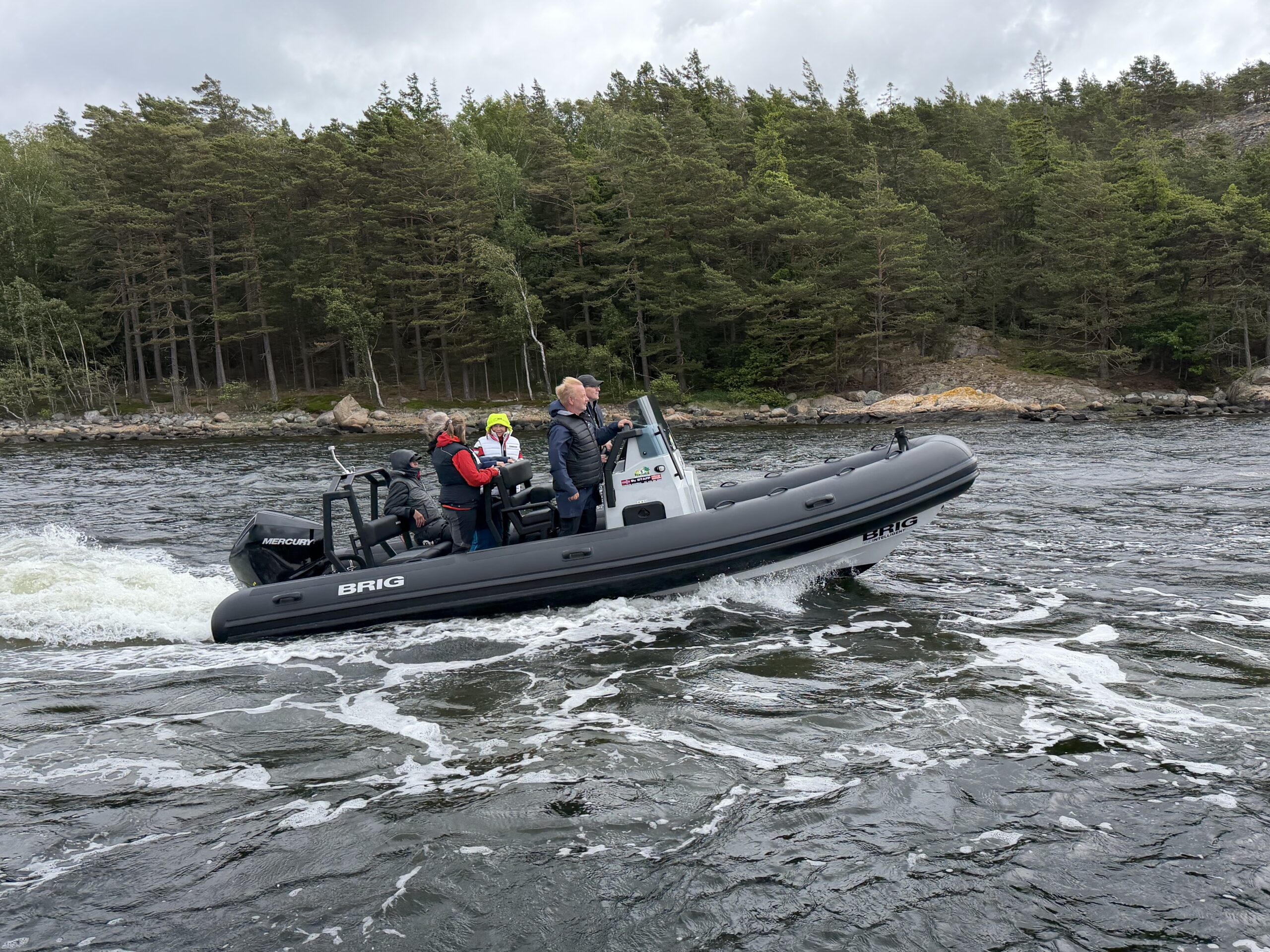
{Low three-quarter bow photograph of a BRIG travelling into moderate chop. The bow should be close enough to show the hull entry and spray deflection clearly, while still showing the entire boat. Prefer a natural sea state rather than deliberately created wake. This should visually demonstrate the bow “working” rather than simply advertise the boat.}
Then come the chines
If you look closely at a planing hull, you may notice that the bottom isn’t simply one continuous V-shaped surface. There can be distinct edges or transitions where different surfaces meet. These are chines.
Chines can influence several aspects of a boat’s behaviour, including stability, spray control, lift and how water leaves the hull. Their exact shape and position are part of the designer’s toolkit. A chine isn’t simply “good” or “bad”. It is a design feature whose effect depends on the complete hull geometry.
This is why two boats with similar overall dimensions can behave very differently. The designers aren’t just choosing the angle of the V. They’re shaping an entire three-dimensional surface.
And what are strakes?
Strakes are another detail you may notice when looking underneath a planing boat. They are longitudinal features running along the hull. Depending on their design, they can help generate lift, influence directional stability and help control the flow of water leaving the hull.
They can also contribute to spray management. Think of them as part of the hull’s toolkit for telling the water:
“Please leave in this general direction.”
The water does not always listen. Good hull design is partly about persuading it.
{Technical underside photograph of a BRIG hull on a boat trailer, photographed from a low rear three-quarter angle. Clearly show the V-shaped running surface, chines/longitudinal hull features and transom. No people blocking the hull. The photograph should be useful enough that an editor could point at individual features and explain them.}
Why not simply make the V deeper and deeper?
Because boats are full of compromises. If deeper is always better, somebody would eventually build a hull shaped like a knife blade and call it a day.
They haven’t.
A very deep-V can offer excellent wave-entry characteristics, but it can also affect:
- stability at rest
- efficiency
- acceleration
- engine requirements
- interior space
- draft
- handling characteristics
The designer therefore has to decide what the boat is supposed to do. A family RIB spending most of its life cruising along a Mediterranean coastline does not necessarily need exactly the same hull philosophy as a specialist offshore craft. A yacht tender has different priorities again.
And a performance-oriented RIB may make different compromises in favour of acceleration and handling. This is why “the deepest V wins” is not a useful way to choose a boat. The right hull is the one whose compromises match your boating.
(Internal link: How to Choose the Right RIB for Your Life on the Water)
Hull length matters too
Here’s another reason specifications can be misleading. A hull does not experience a wave simply according to its deadrise. Length matters. A longer hull can interact differently with a given wave pattern than a shorter one.
This is one reason larger RIBs often feel fundamentally different from smaller boats even when both use the same basic deep-V concept.
BRIG’s Eagle range, for example, applies the deep-V concept across boats of substantially different sizes, with the larger models combining hull length and beam with wide tubes and extended waterlines.
The result isn’t simply “the same boat, but longer”. Everything has to scale and evolve together.
The waterline is more important than it looks
The waterline is the portion of the boat’s length actually interacting with the water.
Designers can use an extended waterline to influence the boat’s behaviour in motion, including efficiency, directional stability and the transition onto the plane. This is one reason BRIG’s product descriptions frequently mention extended waterline length alongside deep-V hulls.
And it is a useful reminder that the boat you see sitting on a trailer isn’t necessarily the same hydrodynamic object you see once it is running at sea. At rest, you see a boat. At speed, you see a system.
Why do some RIBs feel dry?
A dry ride isn’t simply a matter of having a deep-V. Spray management involves the bow shape, chines, strakes, tube position, hull geometry, speed and trim. The tubes themselves can also play a role in helping keep spray away from the occupants.
BRIG’s current and previous model descriptions repeatedly emphasise the combination of deep-V hulls, tube geometry and extended waterlines in pursuit of a dry, stable ride.
But “dry” should never mean “the boat never gets wet”. If you’re boating in a RIB, there is a reasonably good chance that water will eventually find you. It is part of the arrangement. The goal is simply that the boat sends most of it somewhere more useful. Preferably behind you.
What makes a BRIG hull different?
This is where the conversation moves from general RIB theory into BRIG’s own design philosophy.
BRIG has described its design process as drawing on marine and aeronautical engineering experience, with hull development focused on handling, stability and performance. Its Navigator material, for example, describes a V-hull combined with wide tubes and a layout developed around stability and practical use.
The interesting part is that there is no single feature responsible for how a RIB behaves. It is the interaction between:
Hull shape + deadrise + chines + strakes + waterline + tubes + weight + engine + trim + loading.
Change one, and the others have to make sense with it. That’s what boat design really is. Not adding impressive features to a specification sheet. Making hundreds of relatively small decisions agree with one another.
[Ask BRIG Chief Engineer: “When you change the hull geometry, which other parts of the boat usually have to change with it?”]
[Ask BRIG Chief Designer: “Which hull feature do customers see every day but almost never realise was designed for a specific reason?”]
So, is a deep-V always better?
No. And this may be the most important thing to remember. There is no universally perfect hull.
A deep-V is a particularly useful solution when you want a combination of performance, directional control and a more progressive ride in chop. But the best boat for you depends on where you boat, how fast you travel, how many people you carry, how you store the boat and what you expect it to do.
The best hull is therefore not necessarily the one with the biggest number in the specification sheet. It is the one that behaves the way you need it to.
The bit you actually notice
All of this engineering eventually produces something much less technical.
A feeling.
The bow meets a wave. The boat rises. The hull lands cleanly. The steering stays predictable. The passengers keep talking instead of looking at you accusingly. And suddenly you understand why hull design matters. You don’t need to know the precise deadrise angle to enjoy a well-designed RIB. You just need to notice the difference. The numbers are there for the engineers.
The ride is there for everyone else.
(Internal link: What Makes a RIB Fast? Hull Shape, Weight and Power Explained)
(Internal link: How to Choose the Right RIB for Your Life on the Water)
(Internal link: Explore the BRIG Eagle range)
(Internal link: Explore the BRIG Navigator range)